

Beyond the Book Vol. 5 - New Grads Are Walking Into a Different Job
Welcome to issue #016 of New Age Accounting — Vol. #5 of Beyond the Books.

New Grads Are Walking Into a Different Job
The job a new accountant walks into this year barely resembles the one I started in. Same title, mostly the same work, but the day itself is different. The work that used to fill a staff accountant’s first two years is the work a tool now does before lunch.
That one fact explains most of how things look for a new grad right now, both the good and the scary.
They come from the same thing, so I’ll go through them together.
What’s working in their favor
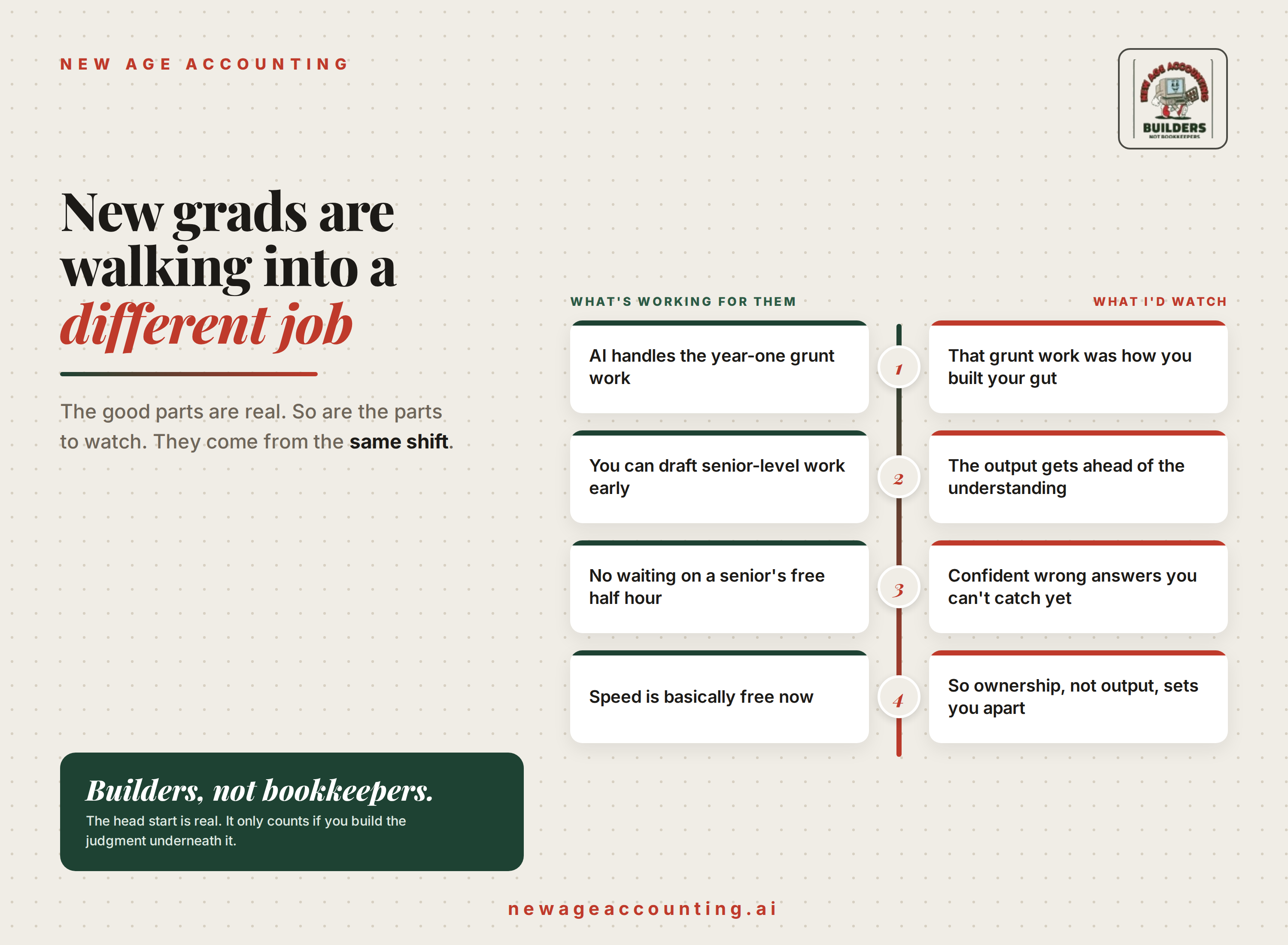
The soul-crushing part of year one is shrinking. The endless ticking, the data entry, the basic recs that used to define the first stretch of a career. A new grad spends less of their early years in the trenches and more of it near the work that’s worth doing.
The output ceiling moved up too. A grad can draft a memo, a variance writeup, a first-pass model at a level that used to take a few years to reach. Looking competent early is easier than it used to be.
The stuff that used to sit behind a senior’s time is open now. How do I treat this, where does it go, what does a good version look like. They’re not stuck waiting for someone to have a free thirty minutes. The question gets answered in the moment they have it.
No unlearning either, which I got into a bit last time. For them the tool was part of the work from the very first task, never something they had to bolt on later.
What I’d flag
The catch is that it’s the same fact seen from the other side. The grunt work that’s disappearing was also the gym.
You built your gut feeling doing the boring reps. A thousand recs and tie-outs taught you what a normal one feels like, so the weird one jumps out at you later. If the tool does the reps, that gut doesn’t build on its own. You have to go build it on purpose, which almost nobody does without a reason to.
The trap that comes out of that is fast-but-shallow. The output looks like a senior wrote it, but underneath, the understanding is still year-one, and the gap is invisible, to the grad and sometimes to the manager, right up until something breaks and they’re the one person in the room who can’t tell that it broke.
A model will also hand you a confident wrong answer with a straight face, and a new grad is the worst-equipped person to catch it. A senior would catch it, because they’ve seen the real number enough times that a wrong one feels off. A grad doesn’t have that yet.
The bar moved too. “It took me all day” used to be a fine answer. It isn’t now, because everyone knows what the tool does in twenty minutes. Speed just gets assumed, so cranking out volume doesn’t set a grad apart the way it once did. What does is owning the work, and being able to stand behind it when someone pushes.
I’d keep half an eye on the door itself, too. If the bottom-rung work is what a tool does now, firms start rethinking how many bottom-rung seats they need. I don’t know how that shakes out yet. Worth keeping an eye on.
So what does a new grad do with this?
The advantage is real, but it runs out if you sit on it. The grad who wins spends the time AI gives back building the judgment it can’t.
Pretty concretely: do some things the slow way on purpose, early, while the stakes are low. Work out why a number is what it is, even when the tool already gave you the number. Get one senior to show you the checks they run, the ones that never show up in the final answer.
None of this is exciting. It’s the deliberate version of the reps you’re no longer forced into, and it’s the part that keeps fast from sliding into shallow.
Your move this week
If you’re early in your career: pick one task you’ve only ever done with a tool and do it once by hand, start to finish, slow. It tells you what you understand on your own versus what the tool’s been quietly carrying for you.
If you manage these folks: take your fastest staff and walk them through one check they don’t know to run yet. Show them how you’d catch the error, the part that never shows up in the final number. Twenty minutes, and it’s probably the best mentoring you’ll do all month.
What part of your first couple years taught you the most, and would a new grad even get that experience today? Hit reply and tell me. I don’t really know the answer to that one yet, and I’m trying to work it out.