

Beyond the Books Vol. 4 - You're Built For This
Welcome to issue #014 of New Age Accounting — Vol. #4 of Beyond the Books. Accountants were born to be AI Power-users. Here's why.

Why Accountants Are Built for the AI Age
Every other week someone sends me an article about which jobs AI is going to wipe out, and accounting is almost always on the list. Data-heavy, rules-based, repetitive. The kind of work a model can supposedly do in its sleep.
I think they’ve got it backwards.
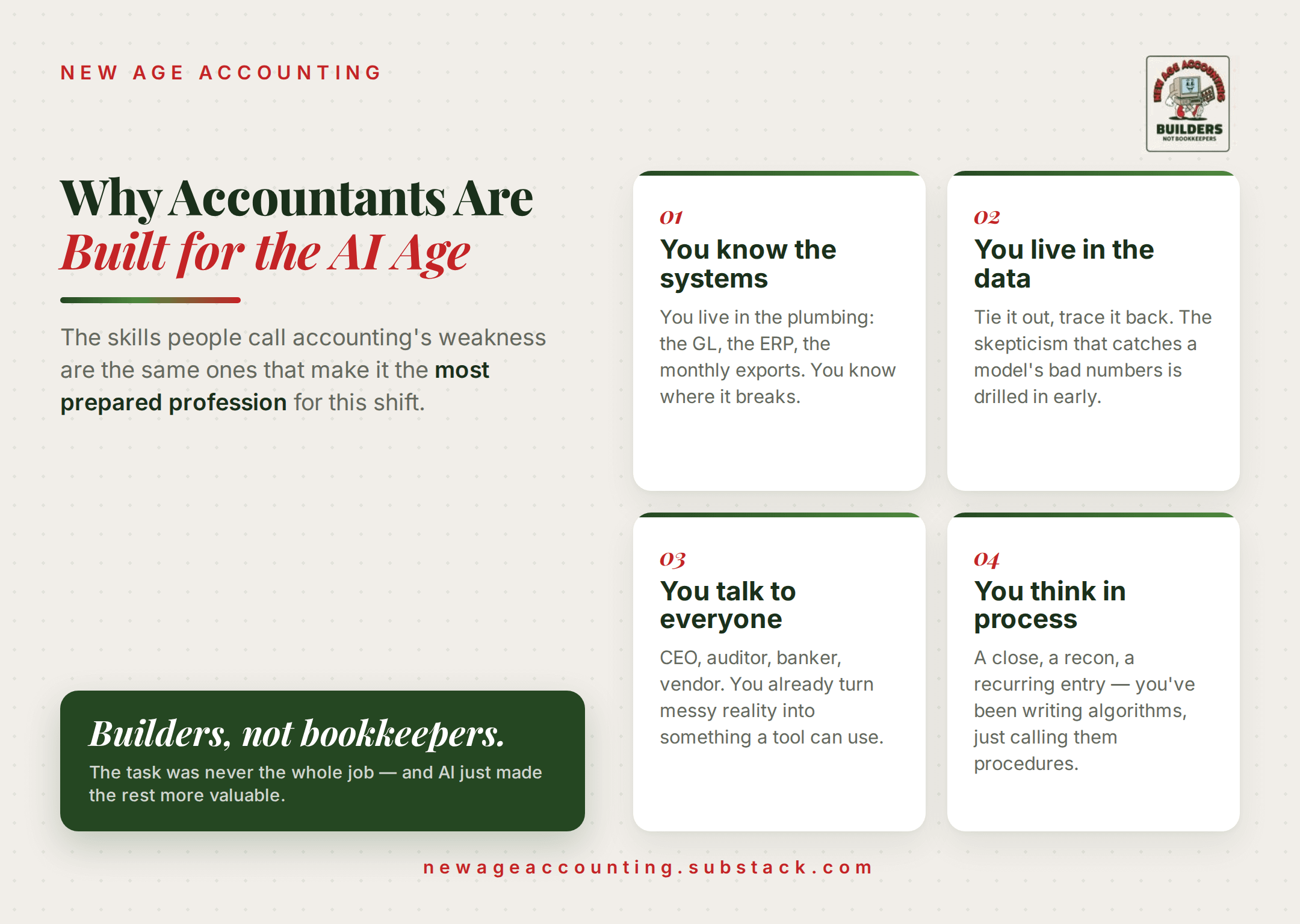
The skills people point to as the reason accountants are at risk are the same skills that make us the most prepared profession for this shift. More prepared than the marketers, the engineers, or the consultants. We just don’t talk about it that way because we’re too busy closing the books.
So let’s go through it.
You already know systems
AI doesn’t do much on its own. It has to plug into something: a GL, an ERP, a reporting layer, a pile of CSVs that somebody exports every month. The value shows up when the tool connects to the actual plumbing of a business.
Accountants live in that plumbing. You know where the data sits, how it moves, where it breaks, and who touches it before it gets to you. You know that a certain subledger doesn’t tie to the GL until the third business day, and why. That kind of knowledge isn’t written down anywhere a model can read it. It lives in your head.
Most people trying to build with AI right now are stuck because they don’t understand the systems they’re trying to automate. You don’t have that problem. You’ve been mapping how data flows through a company for your whole career.
You already live in data
A model will hand you a number and say it with total confidence. Sometimes the number is right. Sometimes it’s made up. The model has no idea which.
You do. Or at least you know how to find out.
Professional skepticism is drilled into accountants from day one. Tie it out. Trace it back. Does this even make sense? We don’t trust an output until it agrees with something else. That instinct, the refusal to take a number at face value, is the single most valuable habit you can bring to working with AI, because these tools hallucinate, and the people who catch it are the ones trained to never trust the first answer.
Interpreting data is the other half. A model can produce a variance table in seconds. Knowing which variance matters most, what’s material, what the CFO is going to ask about: that’s judgment only you have context on.
You already talk to everyone
This one gets overlooked, and I think it might be the most important.
Accountants sit in the middle of the business. In a given week you might talk to the CEO, an auditor, a banker, the sales team, a vendor, and the tax authority. You translate between the people who make the numbers and the people who read them. You’re the connective tissue.
The bottleneck in AI adoption usually isn’t the technology. It’s finding someone who understands the business problem, understands the data, and can explain the whole thing to a tool clearly enough to get something useful back. It turns out accountants are weirdly good at it, because we already spend our days translating messy reality into structured output for an audience.
You already think in process
Stop and look at what a reconciliation really is. Or a month-end close. Or a recurring journal entry.
They’re workflows. Step one, step two, check this against that, flag the exception, document it, move on. You’ve been writing algorithms this whole time, you just called them procedures and stored them in a checklist instead of code.
That’s the same shape as building an automation. The accountants I’ve watched pick up AI fastest aren’t the most technical ones. They’re the ones who already think in repeatable steps, because that’s how they were trained to close the books without missing anything.
The rules thing helps too. We work inside GAAP, inside the tax code, inside our own internal controls. Constraints everywhere. Models happen to work best when you can define the rules and the output you want, and defining rules is most of the job already.
So where does that leave you
I’m not going to pretend the next few years won’t be uncomfortable. Some tasks are going to get automated, probably faster than we’d like. If your whole role is keying in invoices, that part really is at risk, and I’d be lying if I said otherwise.
But the task was never the whole job. The judgment, the systems knowledge, the skepticism, the ability to sit between the data and the people who need to read it, all of that stays. If anything, AI makes it more valuable, because now you can do the boring 80% in a fraction of the time and spend the rest where you add something real.
The accountants who win the next decade won’t be the ones who memorize how a transformer works under the hood. They’ll be the ones who looked at a slow, painful workflow, opened a tool, and tried to build something better. Builders, not bookkeepers.
You’re better positioned for this than almost anyone. Might as well use it.
Your move this week
Pick one task you do every month that follows the same steps every time. A recon, a recurring entry, a report build, whatever you could do half asleep.
Write out the steps the way you’d explain them to a new hire. Then paste that into Claude or ChatGPT and ask it to walk through the process with you using this month’s real data.
You’re not automating anything yet. You’re just seeing how close the tool gets when you hand it the process you already know cold. That’s the whole first step, and it takes about twenty minutes.
What’s the first workflow you’d hand off to AI if you trusted it to get it right? Hit reply and tell me, I read every response.
Accountants have always been system thinkers, connecting all of the dots. I love this framing.